Why Ordinary Places Make Such Effective Horror Settings
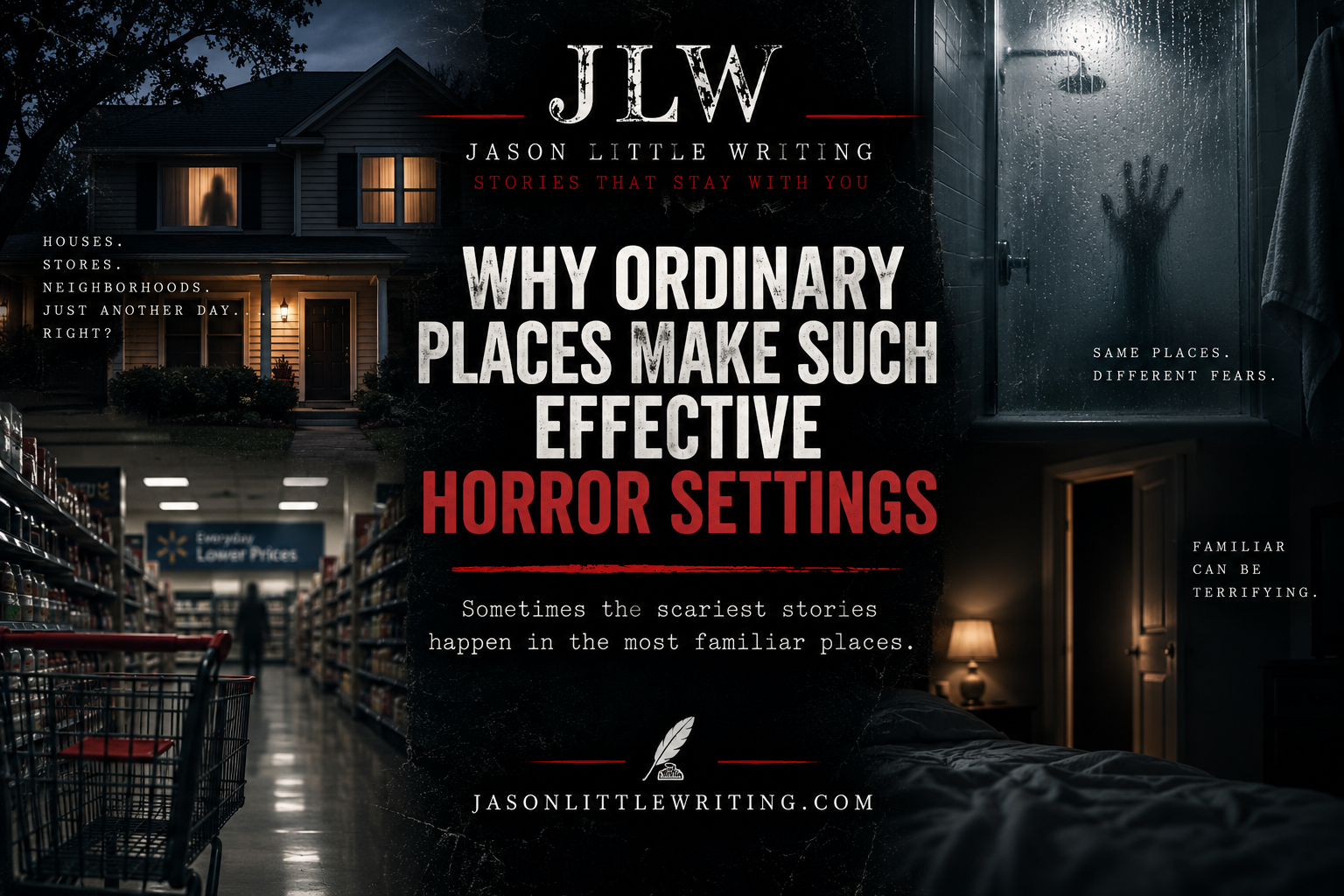
I've always thought one of the easiest ways to weaken a horror story is to try too hard to make the setting scary.
An abandoned asylum at midnight already comes with instructions. The reader knows they're supposed to be nervous. Same with the old cemetery, the boarded up farmhouse, or the cabin twenty miles from the nearest human being.
Put somebody in a Home Depot, though?
Now I'm interested.
I love taking ordinary places and introducing one thing that doesn't belong there. A house. A dentist's office. A hiking trail. A hardware store. A bedroom window.
These are places we've been.
More importantly, they're places where we generally aren't expecting anything terrible to happen.
That's exactly why I think they work so well for horror.
Familiar Places Come With a Sense of Safety
Most of us have a mental map of where we're supposed to be afraid.
A dark alley in a bad part of town? Pay attention.
Walking alone through the woods at midnight? Maybe keep your head on a swivel.
Sitting in your living room at two in the afternoon?
You're probably not worried about much.
Familiar places allow us to relax because we've already decided what they're for. A grocery store is where we buy groceries. A dentist's office is where we get our teeth cleaned. A suburban street is where people walk dogs, mow lawns, and wave at neighbors.
Horror gets interesting when the purpose of that place changes.
John Carpenter understood this beautifully with Halloween. Michael Myers wasn't stalking people through some gothic castle. He was walking around an American neighborhood.
Carpenter has said he wanted Haddonfield to represent the small town people carry around in their minds. In another interview about the setting, he described wanting a picturesque, bright place where you wouldn't expect something terrible to happen.
That last part is what matters to me.
Michael Myers becomes frightening partly because he doesn't belong there.
Then, after watching Halloween, maybe he does.
I Use This Constantly in My Own Horror
I didn't really set out with a rule that my stories needed ordinary locations. Looking back over my Flash Frights, though, I realized how often I naturally gravitate toward them.
In Husband Material, I started at Home Depot.
There is nothing inherently frightening about Home Depot. I've been there countless times. You walk around under fluorescent lights while somebody nearby is trying to figure out which screw fits whatever they're attempting to fix.
That's useful to me as a writer because I don't have to spend much time explaining the world.
You know Home Depot.
So I can spend that time making something go wrong.
I've done the same thing with a dentist's office in Fear of the Dentist. In Best Friends, something as simple as flies gathering on the inside of a window becomes important. No Drinking begins with an ordinary New Year's resolution.
Even when I move outside, I like recognizable situations. Someone going for a hike doesn't immediately scream horror story.
That's the point.
I want the reader standing on solid ground before I start pulling pieces out from underneath them.
Psycho Ruined the Shower
I wasn't alive when Psycho came out in 1960, so I can't pretend to know what seeing that shower scene for the first time felt like.
But more than sixty years later, everybody knows the scene.
That's an incredible accomplishment when you think about the setting.
It's a bathroom.
A shower may be one of the most private and routine places imaginable. You close the door. You take off your clothes. You step inside. For a few minutes, you're vulnerable without usually thinking about being vulnerable.
Alfred Hitchcock found the nightmare already hiding inside that routine.
The British Film Institute's examination of the sequence notes that the famous scene lasts only about 45 seconds, yet required 78 camera setups and 52 cuts. Hitchcock reportedly told François Truffaut that the murder in the bathtub was essentially what made him want to make Psycho.
Hitchcock himself later explained that the bathroom murder remained so strongly in the audience's mind that the movie didn't require the same level of violence afterward.
That's the real achievement.
He took something people did every day and attached a new thought to it.
A horror story gets a lot of mileage when the reader carries it into the real world.
The Exorcist Put Horror Upstairs
The Exorcist does something similar.
The story involves demonic possession, priests, questions about faith, and plenty of supernatural horror. But much of the terror is centered inside a home and, more specifically, inside a child's bedroom.
Bedrooms are supposed to be safe.
A child's bedroom might represent safety more than almost any other room in a house.
Then Regan is upstairs.
Suddenly the bedroom door becomes a boundary between normal life and something awful.
The real locations helped too. William Peter Blatty attended Georgetown University, and Georgetown's own history of the movie explains that he first encountered the story of an alleged Maryland exorcism while he was a student there. Years later, portions of the film were shot around Georgetown and its campus.
There's something I love about that.
One of the most famous supernatural horror stories ever made is connected to dormitories, neighborhood streets, a family home, and a set of stairs people once used as a shortcut.
Ordinary geography becomes horror geography.
The Reader Does Some of the Work for You
There's another practical reason I like familiar settings, especially when I'm writing short horror.
They're efficient.
If I write:
She pushed her cart through Walmart.
I don't need another 300 words describing Walmart.
You've probably already built it in your head.
You can hear the wheels rattling on the cart. You know what the fluorescent lighting looks like. You can picture the aisles. You probably have a vague idea of how the place smells.
Now imagine she reaches the end of an aisle and sees the same man she saw three aisles ago.
Okay.
Maybe coincidence.
She turns down another aisle.
There he is again.
I barely have to describe anything because you supplied most of the set yourself.
For someone writing flash fiction, that's incredibly valuable.
Every word I don't have to spend building the grocery store is a word I can spend making you regret walking into it.
Normal Gives Horror Something to Destroy
I think contrast is doing a lot of the work here.
If everything feels sinister from the opening sentence, the story has nowhere to go.
Give me a normal Tuesday.
Let somebody complain about traffic. Let them stop for coffee. Let them worry about whether they're going to be late for work.
Then put something impossible in the passenger seat when they come back to the car.
The ordinary world gives the strange thing weight.
This is also why I don't necessarily need my characters to be investigating ghosts, hunting monsters, or exploring forbidden places.
I often prefer people who were trying to get through their day.
They didn't volunteer for the horror story.
The horror story found them.
Ordinary Settings Follow the Reader Home
This might be the biggest advantage of all.
Most readers aren't going to spend tomorrow night exploring an abandoned mental hospital.
They probably will take a shower.
They'll walk through their house after dark.
They'll look out a window.
They'll go shopping.
They'll drive to work.
They'll lie in bed and notice the bedroom door isn't completely closed.
When horror occupies one of those spaces, the story gets another chance at the reader after they've finished reading it.
That's what I'm usually chasing.
I don't necessarily need you frightened while you're reading one of my stories.
I'd rather have you finish it, move on with your evening, and forget about me.
Then three hours later, you walk into the kitchen.
Something from the story comes back.
You look toward the dark hallway.
And for just a second, the place you've walked through a thousand times feels different.
That's when I know the setting worked.
Because the story stayed behind.