Why Short Horror Needs a Strong Final Image
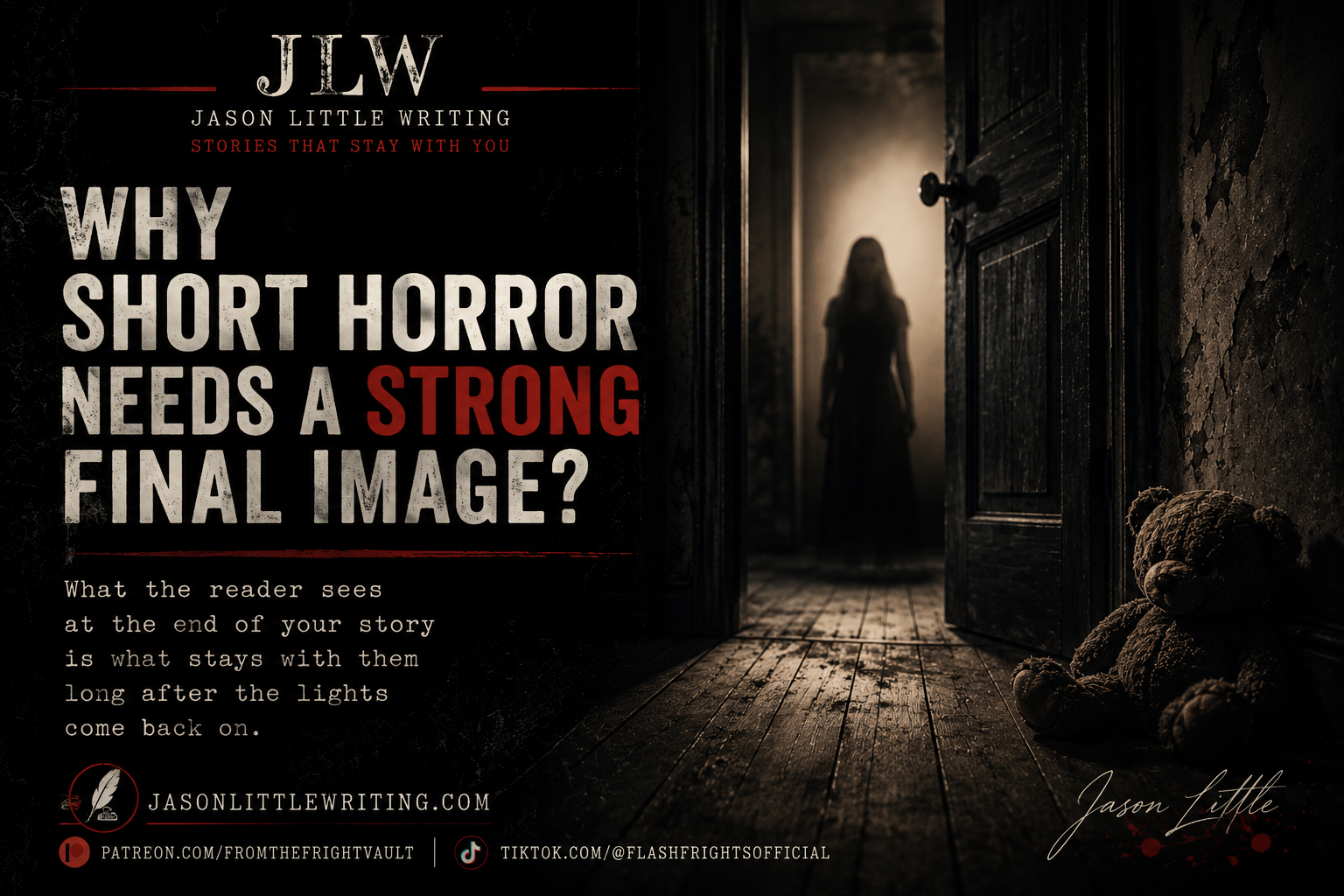
There isn't much room to hide in short horror.
In a novel, you have hundreds of pages to build a world, develop characters, plant ideas, wander down a few dark hallways, and eventually bring everything together. Short horror doesn't give you that luxury. Flash fiction gives you even less.
You have to get in, do the damage, and get out.
I've written a lot of short horror through my Flash Frights series, and one thing I've become increasingly conscious of is what I leave the reader with. Not necessarily the final sentence. Not even necessarily the twist.
The final image.
Because when a short horror story works, I don't think readers remember every sentence. They remember what they saw in their heads when it ended.
And sometimes that image follows them a lot longer than the story itself.
The Reader Has to See Something
Horror is visual even when there isn't a camera involved.
Think about the stories that have stayed with you. Chances are, there's an image attached to them.
A doorway that shouldn't be open.
Someone standing at the end of a hallway.
A child's empty bedroom.
A person staring into a mirror and realizing the reflection isn't doing quite the same thing.
The image doesn't have to be violent. It doesn't even have to show the monster.
Sometimes the most disturbing image is the one that tells the reader something terrible has happened without actually showing them what happened.
That's especially important in short horror because there isn't much time for the reader to live inside the story. You might only have 500 words. Maybe 1,000. Maybe 3,000.
Whatever the length, you're borrowing their imagination for a few minutes.
Before you give it back, put something in there.
A Twist and a Final Image Aren't the Same Thing
I love a good twist.
Anyone who has read enough of my Flash Frights probably knows that.
But I've also learned that a twist by itself isn't always enough.
A twist is information.
A final image is experience.
The twist might be:
The thing under the bed was real.
The image is:
The empty space beneath the bed after Dad disappears underneath it.
Those aren't the same thing.
One tells you what happened.
The other makes you see it.
That's the difference I'm looking for when I reach the end of a short horror story.
If all I've done is explain the surprise, I probably haven't finished yet.
I want to find the image that contains the surprise.
The Ending Should Change What Came Before It
The best horror endings don't just finish the story. They reach backward.
Suddenly something from page one means something different.
A harmless object isn't harmless anymore.
A strange comment makes sense.
Something the protagonist dismissed becomes horrifying.
Or maybe the reader realizes the danger was sitting in plain sight the entire time.
That's one of the reasons Shirley Jackson's The Lottery remains such an effective piece of short fiction decades after its original publication in The New Yorker. The ordinary setting and communal ritual eventually reveal themselves as something completely different from what the reader initially assumes.
That kind of ending rewards the reader for paying attention.
It also makes the story bigger than its word count.
The story might be over, but now the reader is mentally replaying it.
That's exactly where I want them.
Don't Explain the Image to Death
This is something I have to watch in my own writing.
Writers want to make sure readers understand.
So we explain.
Then we explain the explanation.
Then, just to be safe, we add another paragraph explaining what the previous explanation meant.
Horror usually gets weaker every time we do it.
If you've created the right final image, trust it.
Let the reader connect the last few dots.
There's a strange relationship between the horror writer and the reader. We're controlling the story, but the reader is doing part of the work. Shirley Jackson once described the reader as a kind of silent partner in fiction, which I think is especially true with horror.
I can tell you there's something in the dark.
Your imagination gets to decide what it looks like.
And your imagination knows exactly what scares you.
Sometimes my job is simply knowing when to stop talking.
The Final Image Doesn't Have to Be Loud
One of the mistakes we can make writing horror is assuming the ending has to be enormous.
Monster attacks.
Blood everywhere.
Someone screaming.
The world ends.
Those endings can work, but horror doesn't require volume.
Some of the strongest final images are quiet.
A phone ringing in an empty house.
A family photograph with one additional person in it.
A bedroom door slowly opening.
A dog staring at the corner of a room.
An unread text message from someone who died an hour ago.
That's enough.
Maybe more than enough.
Because now the story has ended, but something is still happening.
The reader just doesn't get to see what happens next.
Leave the Door Open an Inch
I don't mean every horror story needs an ambiguous ending.
I mean there should be enough room after the final sentence for the reader's imagination to continue moving.
Neil Gaiman has written about the relationship between writer and reader as a kind of compact: the events of a story need to matter and have consequences. That's particularly useful to remember when writing an ending.
You don't necessarily have to show those consequences.
Sometimes it's stronger if you don't.
Show me the basement door opening.
You don't have to show me what's coming up the stairs.
If you've done everything else correctly, I'll take care of that myself.
And whatever I imagine might be worse than anything you could have described.
The Last Sentence Has One Job
When I'm editing short horror, I sometimes realize I've written one sentence too many.
The story actually ended.
I just kept writing.
That's dangerous.
The last sentence doesn't need to summarize the theme. It doesn't need to explain the twist. It doesn't need to tell the reader how frightened the character is.
It needs to sharpen the final image.
Then get out.
That's one reason short fiction is such a brutal way to learn storytelling. There isn't anywhere to hide the unnecessary stuff.
Neil Gaiman's advice to writers is wonderfully simple: write, finish what you write, and then revise it with fresh eyes.
For short horror, I'd add one more question during that revision:
What does the reader see when this story ends?
If I don't have a good answer, I probably don't have the ending yet.
The Image Is What Follows Them Home
That's ultimately what I'm trying to accomplish with Flash Frights.
I don't have fifty thousand words.
Sometimes I don't even have a thousand.
I have a few minutes with you.
So I want to show you something strange.
Something uncomfortable.
Something that makes perfect sense until suddenly it doesn't.
And right before you leave, I want to put one final image in your head.
Then I'll turn off the lights.
What happens after that is between you and your imagination.