Why Stories Convert Better Than Features
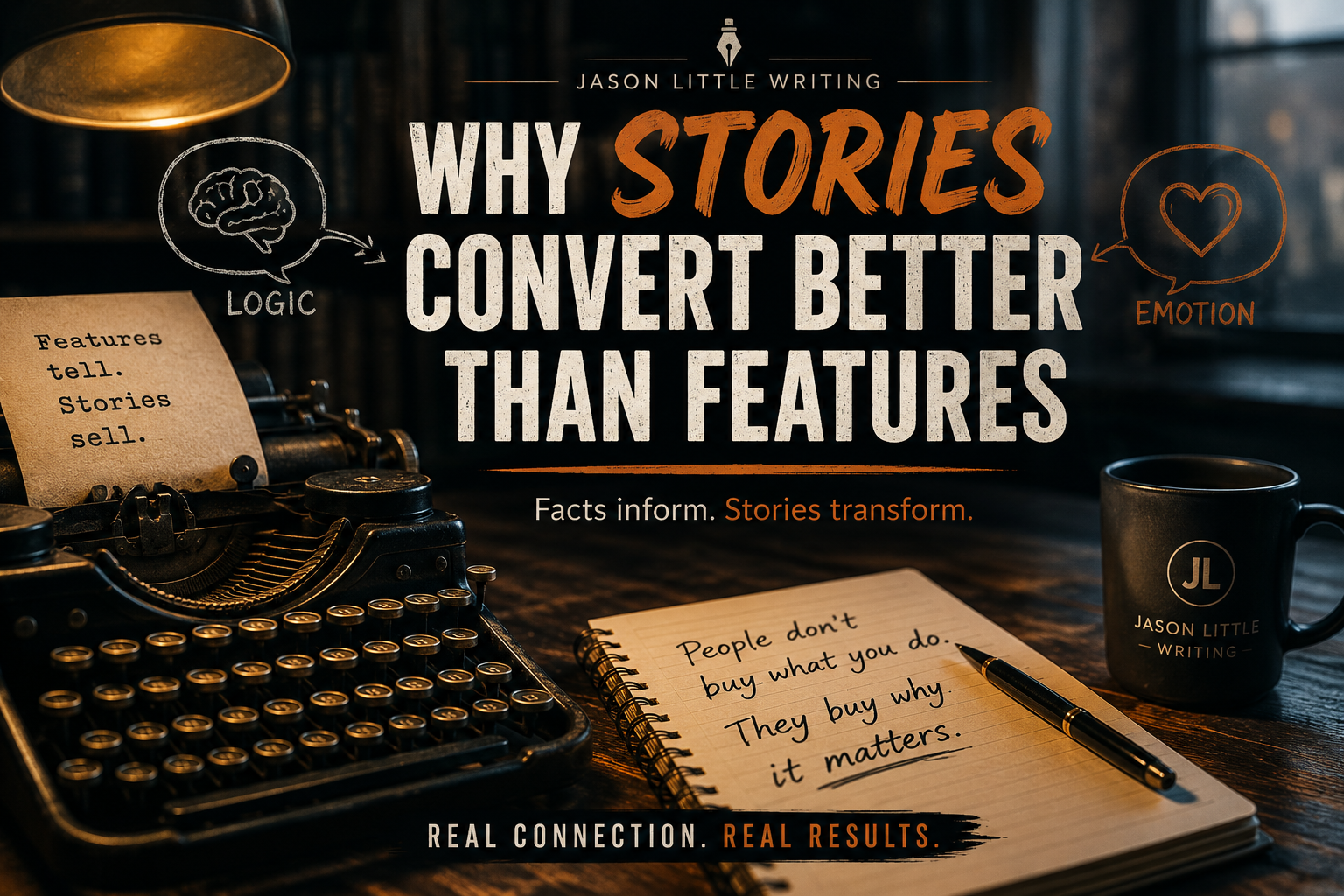
Good stories are about emotions. Good features are about logic. When it comes to selling, emotions will always trump logic. Therefore, stories always win.
There was a time when I thought selling was about explaining things clearly. If I laid out the benefits, listed the features, and stayed organized, people would understand and buy.
That belief worked about as well as trying to win someone over with a manual.
What I’ve learned since then is simple. People rarely move because something is explained well. They move because something feels real. That feeling usually shows up through stories, not features.
Features inform, stories move
A feature tells someone what something is. A story shows what it means in real life.
In insurance sales, I used to open with product details. Coverage amounts. Living benefits. No medical exam language. All technically correct, all easy to understand, and still it would often lead to polite exits.
What started changing results was shifting into real situations. Instead of explaining what a policy does, I started asking questions that pulled out personal context.
Things like:
Who would handle things if something happened to you?
What would you want that money to actually do for your family?
Have you ever had to plan a funeral or help someone with one?
That is where the conversation shifts. Not because the product changed, but because the person starts seeing themselves inside the situation.
A personal example from my work
Recently, I noticed something in my own dialing results that made this obvious.
I had days where I made over 100 calls and only spoke to a handful of people. Most conversations ended quickly with “I’m covered” or “not interested.” The calls where I stayed in longer conversations were almost always the ones where I stopped explaining and started asking.
One appointment came from a call where I barely talked about the policy at all in the first few minutes. I focused on their situation, not my product. That shift alone changed the outcome.
The interesting part is that nothing about the product changed. The only difference was whether the conversation stayed in story mode or slipped into feature mode.
Why storytelling works in sales psychology
There is a reason stories have been used in every culture long before marketing existed. The brain processes stories differently than data.
A feature requires effort. The listener has to translate it into meaning.
A story does that translation automatically.
Research from behavioral psychology supports this. When people hear a story, they activate the same parts of the brain as if they were experiencing the situation themselves.
This is often referred to as neural coupling, and it helps explain why stories feel more convincing than bullet points.
What this looks like outside of insurance
You can see this pattern everywhere.
Apple does not lead with processor speed. They show a person using the device in real life.
Nike does not lead with shoe materials. They tell stories about athletes pushing through limits.
Even in content creation, the most successful writers and podcasters rarely win with pure information. They win with lived experience framed as narrative.
People do not share specs. They share stories.
How I see it in my own writing now
As I’ve been building out my fiction work, especially short horror stories and serialized content, I’ve noticed the same pattern repeating.
When I focus too much on structure or concept, the writing feels flat. When I anchor it in a character experience, even something simple becomes engaging.
That same principle is now bleeding back into everything else I do. Even in business conversations, I find myself thinking less about what I am offering and more about what situation the other person is actually living in.
That shift changes tone, pacing, and results.
Stories work because they reduce resistance
Features create evaluation. Stories create participation.
When someone hears features, they start judging.
When someone hears a story, they start imagining.
Imagination lowers resistance because the person is no longer evaluating a pitch. They are placing themselves inside a scenario.
That is where decisions happen.
What this means for anyone selling or creating content
If I could boil it down to something practical, it would be this:
Start with the situation before the solution.
Let the person recognize themselves first.
Then introduce the product, service, or idea as something that fits inside what they already understand about their own life.
Final thought
I used to think clarity was the goal. Now I think connection is the goal.
Clarity explains things.
Connection moves them.
And connection almost always starts with a story.